We all want the same thing for our animals: more healthy, active years together. ❤️
When we think about helping our dogs live longer, nutrition, maintaining a healthy weight, and regular veterinary care often come to mind. But there’s another important piece of the longevity puzzle:
Movement.
And not just how much our animals move—the type and intensity of that movement matter too.
What Human Exercise Research Can Teach Us
Research and physical activity guidelines on the human side give us an interesting way to think about movement.
As a general guideline:
1 minute of vigorous activity ≈ 2 minutes of moderate activity.
That’s why physical activity recommendations commonly compare about 75 minutes of vigorous exercise with 150 minutes of moderate exercise, such as brisk walking.
But here’s where it gets interesting.
What if you spend 150 minutes cleaning the house?
Vacuuming, doing laundry, mopping, carrying things around, and tidying certainly keep us moving. Some chores can even reach moderate intensity. But lighter household activity isn’t necessarily the same physical challenge as a brisk walk, run, bike ride, or workout.
Being busy and being physically challenged aren’t always the same thing.
And that got me thinking about our animals.
The Same Idea Applies to Our Dogs 🐕
A leisurely walk around the neighborhood is wonderful for a dog.
Sniffing, exploring, and investigating every blade of grass provides physical activity AND important mental stimulation. I’m certainly not suggesting we eliminate the sniff walk!
But a leisurely stroll isn’t the same physical challenge as:
- Trotting or running
- Playing fetch
- Swimming
- Hiking
- Climbing hills
- Playing with another dog
- Performing appropriate strengthening exercises
- Moving across different surfaces and terrain
Different activities challenge the cardiovascular system, muscles, joints, balance, coordination, and nervous system in different ways.
That’s why the goal isn’t necessarily MORE movement. The goal is varied, appropriate movement.
Movement Should Match the Animal
This is especially important: vigorous exercise isn’t appropriate for every dog.
A young, healthy, athletic dog has very different physical needs and abilities than a senior dog, a puppy, or an animal dealing with arthritis, injury, neurologic disease, or another health condition.
For one dog, vigorous activity might mean sprinting after a ball.
For another, walking up a gentle incline may be plenty of a challenge.
And for a senior dog, simply getting up and down, navigating different surfaces, or doing controlled strengthening exercises may be meaningful exercise.
The goal is to find movement that is appropriate for the individual animal’s age, health, fitness level, and physical abilities.
Why Movement Matters for Healthy Aging
As animals age, maintaining mobility becomes increasingly important.
Appropriate regular activity can help support muscle strength, cardiovascular fitness, balance, coordination, joint mobility, body weight, and the ability to continue doing everyday activities.
And those are the things that help our animals continue to live their lives—not simply accumulate birthdays.
As an animal chiropractor, this is one of the reasons I pay so much attention to changes in movement. Slowing down, hesitating to jump, difficulty getting up, slipping, changing gait, or no longer wanting to participate in favorite activities shouldn’t automatically be dismissed as:
“They’re just getting old.”
Sometimes those little changes are the first signs that an animal is moving differently or compensating.
And Yes…This Applies to the Humans Too! 😂
Maybe our dogs can teach us something about our own longevity.
Get off the couch. Get the dog off the couch. And get moving together!
Take the walk. Find a hill. Play. Explore. Move at different speeds. And choose activities that are appropriate for both ends of the leash.
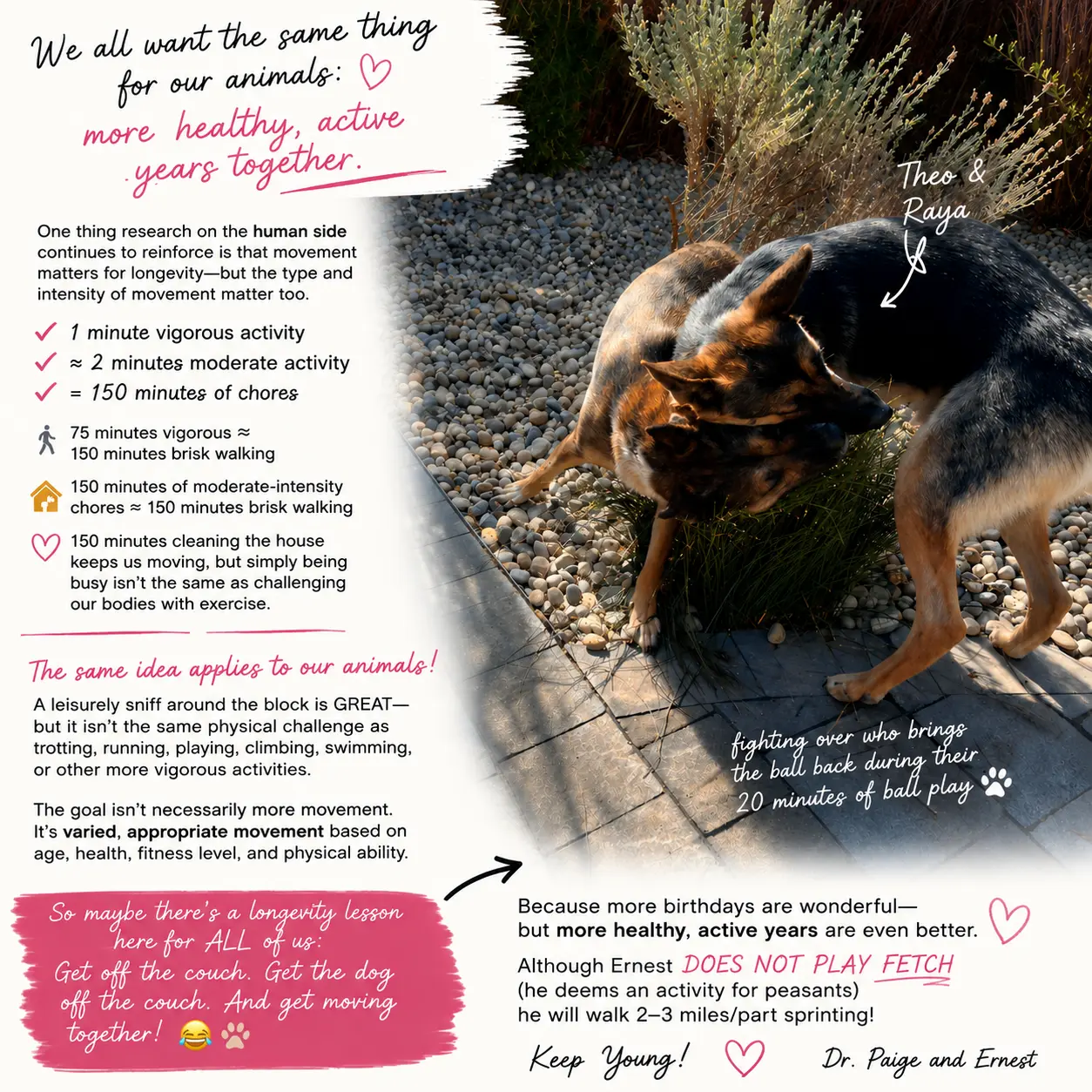
At my house, Theo and Raya will happily turn 20 minutes of ball play into a full-contact sporting event while arguing over who gets to bring the ball back.
Ernest, on the other hand, DOES NOT PLAY FETCH.
Apparently, fetch is an activity for peasants.
He will, however, happily walk 2-3 miles—with a little sprinting mixed in—because everyone apparently gets to choose their preferred form of exercise. 😂
The takeaway?
More birthdays are wonderful. More healthy, mobile, active years are even better.
Keep moving. Keep playing. Keep young! 🐾