As pets age, play hard, or go through injuries, their movement starts to change. You might notice your dog slowing down on walks or your cat hesitating to jump onto the bed. One of the most important questions I ask as an animal chiropractor is:
Is this mostly stiffness, or mostly weakness?
They can look similar on the surface, but they are very different problems—and they need different kinds of help.
In this post, I’ll break down what stiffness and weakness look like in pets, how you can spot the difference at home, and how chiropractic care fits into the picture.
What Is Stiffness in Pets?
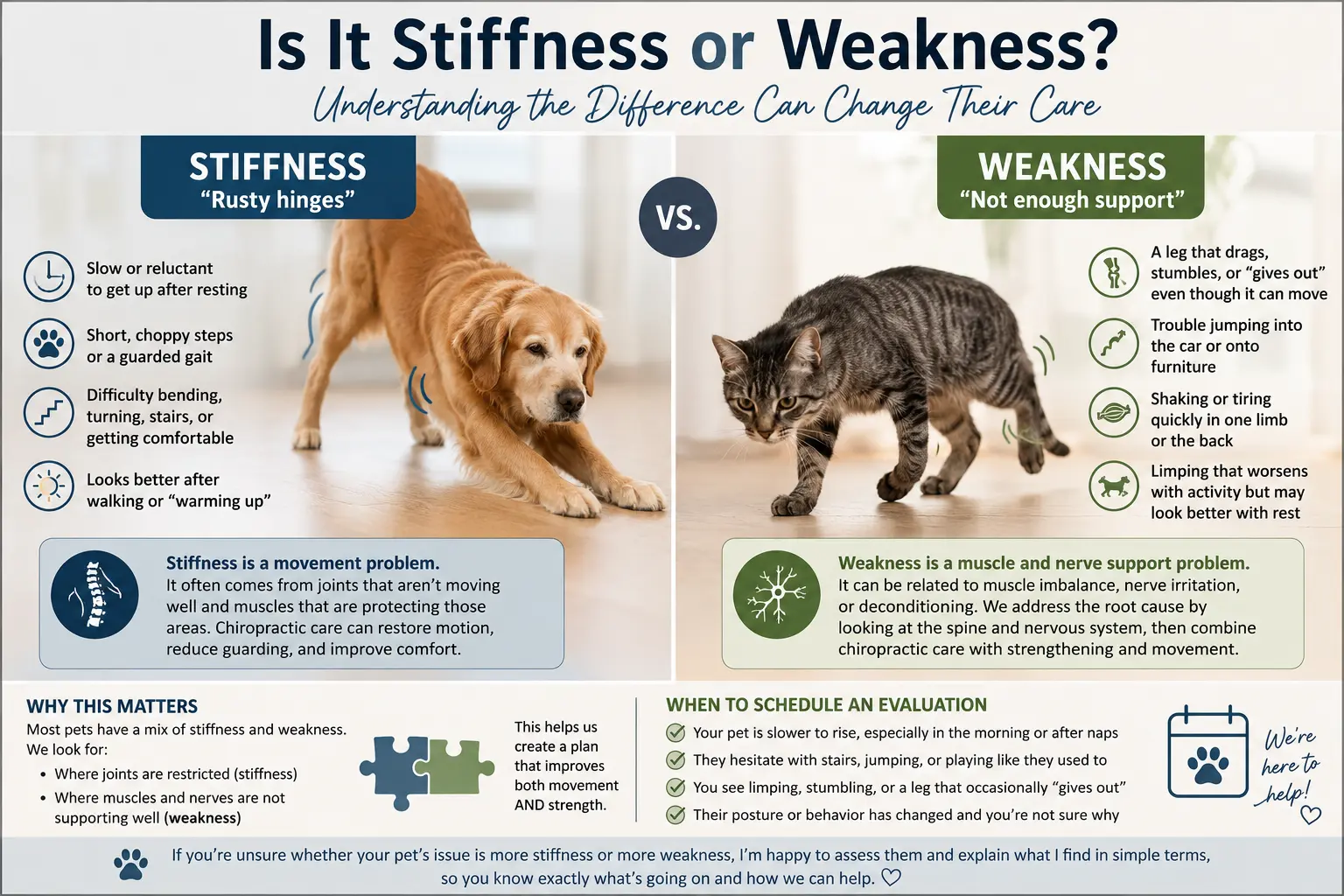
Stiffness is mainly a movement problem. Think of a door with rusty hinges: it can open, but it resists at first and feels tight or restricted.
In pets, stiffness usually shows up as:
- Slow or reluctant to get up after resting
- Short, choppy, or guarded steps
- Difficulty bending or turning, going up or down stairs, or curling up to sleep
- Moving better after “warming up” and walking around
What’s happening under the surface?
- Certain joints are not moving the way they’re supposed to.
- Muscles around those joints tighten or “guard” to protect the area.
- The nervous system senses restriction and responds by limiting motion.
From a chiropractic perspective, stiffness often means joint restriction plus protective muscle tightness. If we only stretch tight muscles without restoring proper joint motion, relief is usually temporary. The body will keep tightening up again to protect that restricted area.
By gently improving joint motion, we help:
- Reduce the need for muscles to guard constantly
- Restore more natural, comfortable movement
- Make stretching, exercise, and play feel easier and safer
What Is Weakness in Pets?
Weakness is more of a muscle and nerve support problem. Here, the joints may move fairly well, but the muscles and nervous system can’t fully support that movement.
Weakness in pets can look like:
- A leg that drags, stumbles, or occasionally “gives out”
- Trouble jumping into the car, onto furniture, or navigating stairs
- Shaking or tiring quickly in one limb or through the back
- Limping that worsens with activity but may improve after rest
What’s going on underneath?
- Muscles may be underused, poorly conditioned, or imbalanced.
- Nerve signals from the spine to the limb may be irritated or compromised.
- The body recruits other areas to compensate, which can create new problems over time.
From a chiropractic standpoint, weakness often involves nerve irritation, muscle imbalance, or deconditioning. If we only push through exercise without addressing how the joints and spine affect the nerves, we can overload already struggling tissues.
Supporting weakness means:
- Improving joint and spinal alignment to optimize nerve communication
- Identifying which muscles are not pulling their weight
- Adding specific strengthening and coordination exercises, not just random activity
Stiffness vs. Weakness: How You Can Tell at Home
Here’s a simple way to think about it:
- Stiffness: The body doesn’t want to move. Once it’s moving, things often improve.
- Weakness: The body can move, but it can’t support that movement very well.
A few practical “at home” questions:
- How do they look after rest?
- Very slow or rigid when first getting up, then better after walking = more stiffness.
- About the same getting up, but a limb starts to falter during activity = more weakness.
- What happens with stairs or jumping?
- Hesitates because it looks uncomfortable or tight at the start, then manages = likely stiffness.
- Tries, but can’t push off, misjudges, or the leg gives out = likely weakness.
- How long can they hold a position?
- Position looks rigid or guarded, but they can hold it = more stiffness.
- Position looks wobbly or shaky, and they tire quickly = more weakness.
Of course, many pets have both stiffness and weakness in different areas—this is very common in seniors, active dogs, and pets recovering from injury.
How Animal Chiropractic Care Helps
When I examine a pet, I’m not just looking for “where it hurts.” I’m systematically assessing:
- Which joints are restricted or misaligned (stiffness)
- Which muscles and nerves aren’t supporting well (weakness)
- How posture, gait, and behavior tie into those findings
For stiffness, chiropractic care focuses on:
- Restoring motion in restricted joints
- Reducing protective muscle tension
- Improving overall mobility so movement feels smoother and less guarded
For weakness, chiropractic care focuses on:
- Optimizing spinal and joint alignment for clearer nerve signaling
- Identifying key muscles that need targeted strengthening
- Coordinating with appropriate exercises and lifestyle changes to rebuild support
The goal is not just to make your pet move differently in the exam room—it’s to help them:
- Get up more comfortably
- Walk, run, and play with more ease
- Feel steadier and more confident in everyday life
When Should You Consider an Evaluation?
You don’t need to know whether it’s stiffness or weakness before you come in. That’s my job. But it is helpful to pay attention to patterns and changes.
Consider scheduling an exam if you notice:
- Your pet is slower to rise, especially in the morning or after naps
- They hesitate on stairs or with jumping, or avoid activities they used to enjoy
- You see limping, stumbling, or a leg that occasionally drags or collapses
- Their posture or behavior has changed, and you’re not sure why
During an appointment, I’ll explain what I find in simple terms—how much of their issue is stiffness, how much is weakness, and what that means for their care plan.
Final Thoughts
Stiffness and weakness are two different ways the body signals that something needs attention. Knowing the difference helps us choose safer, more effective options for your pet—whether that’s gentle chiropractic adjustments, targeted exercises, lifestyle changes, or a combination of all three.
If you’re wondering whether your dog or cat might be dealing with stiffness, weakness, or both, you’re welcome to reach out. I’d be happy to help you understand what’s going on and what we can do to support your pet’s comfort and mobility.
You can call/text the office at 408-385-1849 or to schedule in Danville – https://awcdanville.com/ or Oakland – https://www.creaturecomfort.com/